This guide is for owners of older Dubai apartments who are planning a bathroom renovation, whether for their own use or for a rental. The short answer: a bathroom is a small room with a lot of hidden work. Most of the value sits in the stages you will never see once the tiles are on, so that is where to check most carefully.
We set out the stages in order, what each one involves, how long it typically takes relative to the others, and what to check before it gets covered up.
Why the hidden work matters most
In a rental, a leak is one of the costliest failures you can have. It can damage the unit below, take the bathroom out of use, lead to a dispute with neighbours or the building, and cost you rent and goodwill. Good waterproofing, sound pipework and correct falls to the drain do not show in listing photos, but they protect the asset for years.
That is the ROI logic of a bathroom renovation: spend first on what prevents failures, then on what the renter sees and uses every day.
Before work starts: approvals and planning
Most buildings require a written NOC before any work starts, even for a bathroom, and requirements vary by building. It usually covers the scope and drawings, the contractor’s licence and insurance, a refundable deposit, working hours, service-lift booking and debris removal.
Keeping the bathroom where it is matters for both cost and approvals. Like-for-like replacement of tiles and fittings typically needs no municipal permit, while relocating a wet area or rerouting MEP typically needs a modification permit from the relevant authority (Dubai Municipality, DDA or Trakhees, depending on where the building is). If you add electrical load, for example a new heater circuit, check whether DEWA approval is needed. Our guide to renovation NOC in Dubai explains each route.
Buildings also set their own working hours and often restrict noisy work, such as breaking tiles, to certain times. That affects how many days demolition takes.
The stages of a bathroom renovation
| Stage | What happens | Typical duration (relative) |
|---|---|---|
| 1. Survey and design | Measurements, layout, fittings and tile selection, drawings for the NOC | Depends mostly on decisions and building approval |
| 2. Protection and strip-out | Protect corridors and lift, remove tiles, fittings and old screed where needed | Usually short, limited by noisy-work hours |
| 3. Plumbing and electrical | New supply and drain pipes, concealed cisterns, electrical points | Short to moderate; longer if pipes are rerouted |
| 4. Screed and falls | Levelling the floor and forming the slope to the drain | Includes drying time that should not be rushed |
| 5. Waterproofing and flood test | Membrane on floor and up the walls, then a ponding test | Curing plus a test day; do not compress |
| 6. Tiling | Wall and floor tiles, grouting, sealing | Often the longest single stage |
| 7. Fit-off | Vanity, WC, shower glass, mirrors, lighting, accessories | Short, but depends on deliveries |
| 8. Testing and handover | Pressure and flow checks, silicone, snag list | Short |
Overall timing typically depends on the building’s working rules, how quickly fittings are chosen and delivered, and whether hidden problems appear at strip-out. A like-for-like bathroom moves much faster than one where pipes or the layout change. We do not give a fixed number of weeks without seeing the apartment and the building rules. For the full apartment picture, see how long an apartment renovation takes in Dubai.
What to check at each stage
After strip-out
- The condition of existing pipes, valves and the drain connection.
- Signs of past leaks: stains, damp screed, damaged slab.
- Any provisional items in the estimate, now confirmed and agreed with you before work continues.
Before the walls and floor are closed
- Pipes pressure-tested, with photos of the routing for future reference.
- Electrical points positioned as drawn and kept clear of wet zones.
- Concealed cistern and mixer bodies fixed securely and accessible for service.
Waterproofing
- The membrane runs continuously across the floor and up the walls, with extra height in the shower area.
- Corners, pipe penetrations and the drain are detailed properly.
- Good practice is a 24-hour flood test before tiling. Ask to see it, or a photo of it.
Tiling
- The floor falls towards the drain with no standing water.
- Joints are even, grout is full and movement joints are sealed.
- Large-format tiles sit flat on a levelled base, without hollow spots.
Handover
- Run every tap and shower and flush the WC; check under the vanity for drips.
- Check the extract fan, lighting and mirror lighting.
- Keep a record: photos of hidden works, product details and any changes agreed during the work.
Where to spend and where to save in a rental bathroom
For a rental or holiday home, the bathroom is judged quickly. Clean lines, good lighting, a reliable shower and enough storage matter more than rare materials.
- Spend on: waterproofing, pipework, ventilation, good-quality mixers and a well-fitted shower screen. These reduce call-outs.
- Spend sensibly on: durable mid-specification tiles and sanitaryware that can be replaced easily, ideally the same across your units.
- Usually not worth it in a rental: moving the bathroom, bespoke stone, or fragile finishes that will not survive frequent turnover.
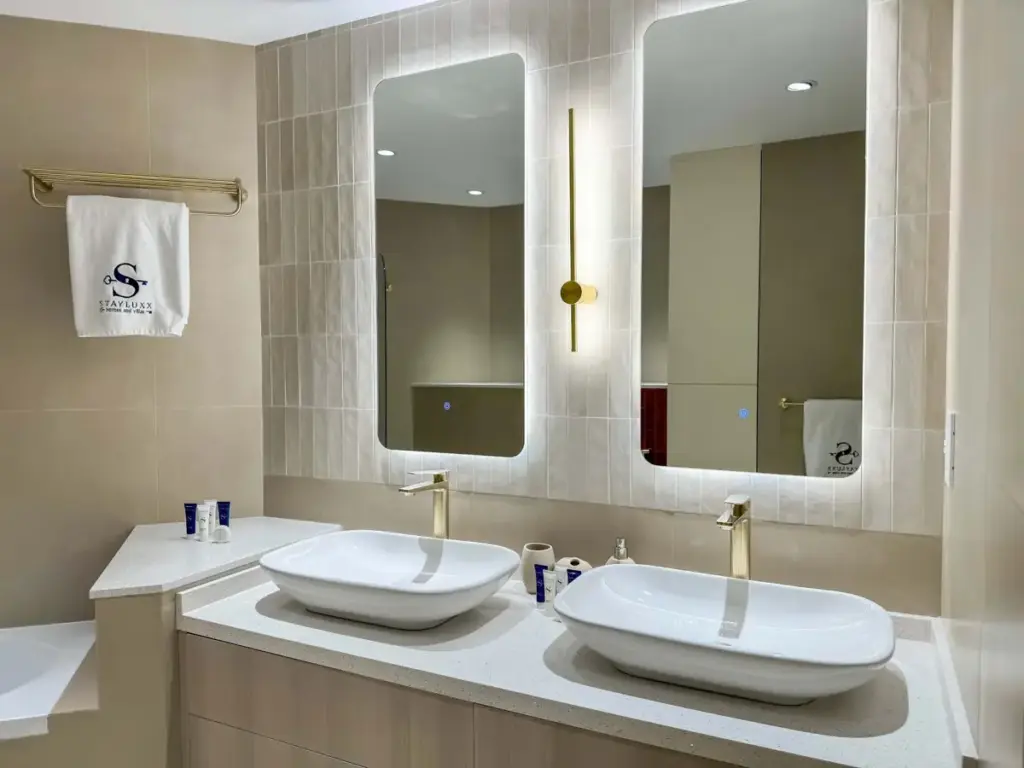
See our bathroom fit-out with a double vanity and backlit mirrors, and the full renovation of an Address studio. If the apartment is for letting, our rental renovation service focuses on what pays back.
FAQ
How long does a bathroom renovation take in Dubai?
It typically depends on scope, building working hours, fitting deliveries and what is found at strip-out. A like-for-like renovation is noticeably faster than one with new pipe routes. The stages that should never be rushed are screed drying, waterproofing and the flood test.
Do I need a NOC to renovate a bathroom?
Most buildings require a written NOC before any work starts. Relocating wet areas or rerouting MEP typically also needs an authority permit; like-for-like replacement usually does not.
Can new tiles go over the old ones?
It is sometimes possible, but it hides the condition of the waterproofing and pipes underneath. In an older apartment, stripping out usually gives more certainty.
What is a flood test?
The waterproofed floor is filled with water and left, typically for 24 hours, to show that nothing leaks before tiles go on. It is good practice rather than a written authority requirement.
Planning a bathroom renovation in an older apartment? Contact FitOut Studio for a survey and an itemised estimate.